

The kids are in bed. Your house in Lexington is finally still. Yet you find yourself replaying the evening’s arguments. Maybe it started with a question about the dishes or the weekend plans. Many couples find themselves in this cycle. You wonder if these are signs a marriage in trouble or it’s just a “rough patch.”
Recognizing relationship warning signs is not about casting blame. It’s about the path forward. Whether you are balancing a high-stress role in Columbia or managing the intricate needs of your family, understanding the patterns of conflict can provide an off-ramp back to the connection you once felt.
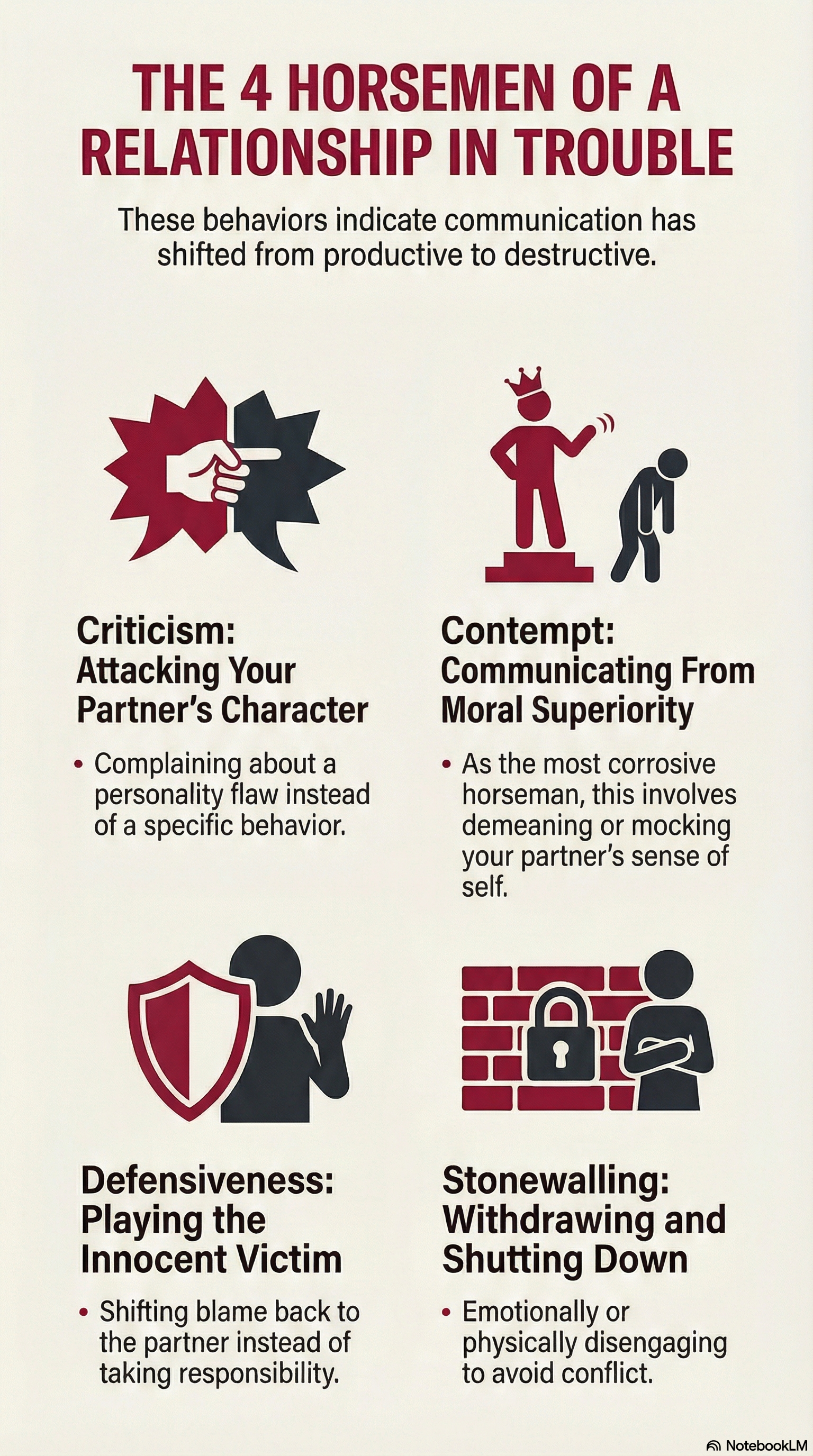
What Are the Four Horsemen of Relationships?
Dr. John Gottman, a leading researcher in marital stability, identified four specific communication patterns that can predict the end of a relationship with startling accuracy. He famously called these “The Four Horsemen of the Apocalypse”. While the name sounds dire, identifying these signs your marriage is in trouble is actually the first step toward healing.
At Crossroads Counseling, we often tell our clients that these horsemen are not death sentences; they are treatable patterns. Most marriages will experience these horsemen at some point, especially during stressful seasons of parenting or career transitions.
The First Horseman: Criticism
Criticism is often the first horseman to enter a marriage, and it is frequently confused with simply having a complaint. A complaint addresses a specific action or behavior: “I was frustrated when the trash wasn’t taken out last night.” Criticism, on the other hand, is an attack on your partner’s character or personality.
Examples of criticism often begin with “you always” or “you never.” It sounds like:
- “You are so selfish; you never think about how your late meetings affect the kids’ bedtime.”
- “Why are you so forgetful? I can’t trust you to do anything right.”
Criticism erodes connection because it makes the recipient feel assaulted and rejected. In a Christian marriage counseling context in Lexington, we see how criticism replaces grace with judgment. It shifts the focus from “we have a problem to solve” to “you are the problem.” When criticism becomes the primary way you communicate marriage communication problems, it paves the way for the more corrosive horsemen to follow.
The Second Horseman: Contempt
If criticism is a character attack, contempt is criticism delivered from a position of moral superiority. Gottman identifies contempt as the single greatest predictor of divorce because it represents a complete lack of respect for one’s partner. It is fueled by long-simmering negative thoughts about the other person.
Contempt often manifests through:
- Sarcasm and Cynicism: Using “jokes” to belittle or mock your spouse’s ideas or feelings.
- Body Language: Eye-rolling, sneering, or mimicking your partner in a mocking tone.
- Hostile Labeling: Calling your spouse names like “lazy,” “idiot,” or “failure.”
Contempt is toxic because it makes it impossible to resolve conflict. When you treat your spouse with contempt, you are essentially saying they are beneath you. For families in South Carolina who value covenant and community, this horseman can feel particularly shameful. Recognizing it is paramount to rebuilding the culture of appreciation that every healthy marriage requires.
The Third Horseman: Defensiveness
Defensiveness is a nearly universal response to criticism, but it rarely leads to a resolution. When we feel unjustly accused, we naturally look for excuses or play the “innocent victim” so our partner will back off. Unfortunately, defensiveness is actually a way of blaming your partner. You are effectively saying, “The problem isn’t me, it’s you.”
Common defensive patterns include:
- Making Excuses: “I only forgot the groceries because your morning schedule was so chaotic.”
- Cross-Complaining: Meeting your partner’s complaint with a complaint of your own to deflect the focus. “Well, you didn’t do the laundry, so we’re even.”
- The “Yes-But” Tactic: Agreeing in theory but immediately providing a reason why you shouldn’t be held accountable.
Defensiveness blocks resolution because it prevents you from taking responsibility for your part in the conflict. In our Lexington office, we work with couples to move past the “courtroom” mentality where each person is trying to win an argument, moving instead toward a “team” mentality where the goal is mutual understanding.
The Fourth Horseman: Stonewalling
Stonewalling occurs when one partner completely withdraws from the interaction, shutting down and stop responding to their spouse. Rather than confronting the issue, the stonewaller might turn away or act busy to avoid the conversation. This usually happens when the person feels “flooded”—physically and emotionally overwhelmed by the conflict.
Gender patterns often emerge here; research suggests that men are more likely to stonewall as a way to self-soothe when they feel their internal “stress alarms” going off. While it may feel like a way to keep the peace, stonewalling is deeply painful for the other partner, who feels abandoned and ignored. It shuts down the very connection needed to fix the signs your marriage in trouble.
If you’re recognizing these patterns in your own marriage, you’re not alone. A counselor can help you rebuild communication before small cracks become deep fractures. Crossroads offers marriage counseling rooted in both clinical skill and faith.
Schedule a free 15-minute consultation to see if we’re the right fit.
The Antidotes: How to Repair These Patterns
The most important takeaway from the Gottman framework is that every horseman has an antidote. You can learn to replace these destructive habits with healthy ones that foster restoration and grace.
- For Criticism, Use a Gentle Start-Up: Instead of attacking, talk about your feelings using “I” statements and express a positive need. “I feel overwhelmed with the housework; could you help me with the kitchen tonight?”
- For Contempt, Build a Culture of Appreciation: Intentionally look for the small things your spouse does right. Expressing gratitude regularly acts as an “immune system” against contempt.
- For Defensiveness, Take Responsibility: Even if you only agree with 5% of what your partner is saying, validate that 5%. “You’re right, I did forget to call you when I was running late.”
- For Stonewalling, Practice Physiological Self-Soothing: If you feel flooded, ask for a 20-minute break. Spend that time doing something calming (like reading or walking) without ruminating on the argument, then return to the conversation.
These tools are simple in theory but difficult to implement when emotions are high. That is why having a neutral, professional guide is often necessary to break the cycle.
When to Seek Marriage Counseling in South Carolina
Self-awareness is the first step, but it is often not enough to change long-standing patterns. If you recognize multiple horsemen in your daily interactions, or if the antidotes feel impossible to implement on your own, it is time to consider when to seek marriage counseling.
At Crossroads Counseling, we offer a faith-informed, practical approach to couples therapy in Columbia, SC, and Lexington. We don’t just “talk about feelings”; we provide a plan from day one to help you stabilize your relationship and rebuild trust. Whether you are dealing with the aftermath of infidelity or simply feel like you’ve lost the spark, our goal is to help you move toward a healthy, lasting covenant.
We serve couples in-person at our Lexington office and throughout all of South Carolina via secure telehealth. We believe that your marriage is worth the effort, and we are here to support you in the work of restoration.
Ready to take the next step? Crossroads Counseling serves couples in Lexington, Columbia, and throughout South Carolina via telehealth. We verify your insurance before your first session and create a plan you help design—no waitlists, no guessing.
Book your first session today >
Crisis and Emergency Guidance:
If you are in a situation involving domestic violence or immediate physical danger, help is available. Contact the National Domestic Violence Hotline by calling 800-799-7233 or texting “START” to 88788. For medical emergencies, call 911 immediately.