

Avoidance feels like relief. When something triggers fear, whether it’s a crowded parking lot, a memory from combat, a dog behind a fence, or the thought of embarrassing yourself in public, stepping away from it makes the anxiety drop. The problem is that the drop doesn’t last, and each time you avoid it, the fear gets a little louder. Exposure therapy is designed to break that cycle at its root.
This article explains what exposure therapy is, how it works, who it helps, and what to expect if you pursue it at a practice like Crossroads Counseling in Lexington, South Carolina.
What Exposure Therapy Is and Why It Works
Exposure therapy is a structured, evidence-based treatment in which a person gradually and intentionally confronts feared situations, objects, memories, or sensations under the guidance of a trained therapist. The goal is not to endure discomfort indefinitely but to let anxiety peak and then fall on its own, teaching the brain that the feared thing is not actually dangerous and that the feeling itself is survivable.
The mechanism behind this is well-established. When the brain repeatedly encounters a feared stimulus without the expected bad outcome, it updates its threat assessment through a process called inhibitory learning. Over time, the anxious response weakens. The American Psychological Association recognizes exposure-based treatments as among the most effective interventions available for anxiety disorders, PTSD, OCD, and related conditions.
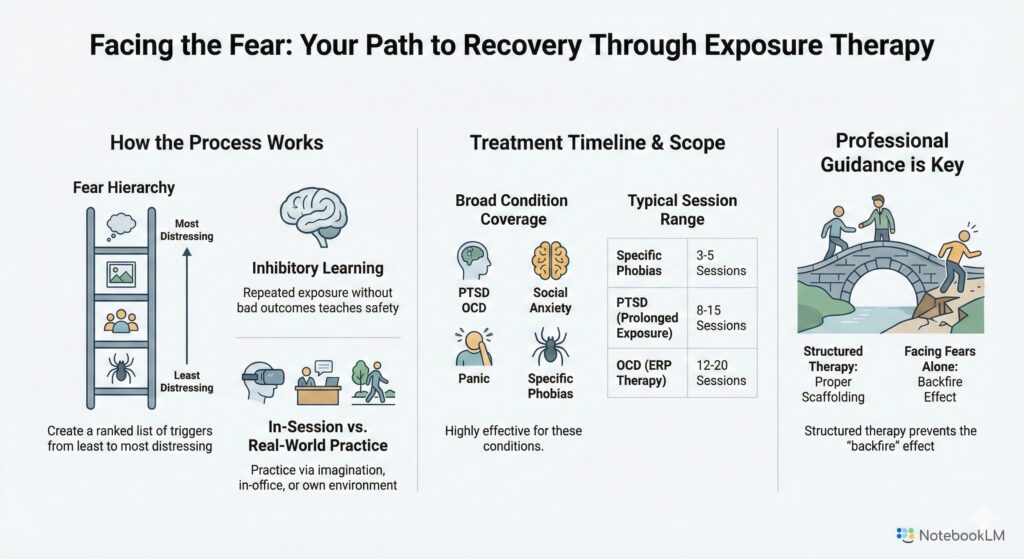
Exposure therapy is not about flooding someone with fear until they give up. A good therapist builds a fear hierarchy with the client, starting with situations that cause mild anxiety and working upward at a pace the client can manage. The structure matters as much as the exposure itself.
Conditions Exposure Therapy Can Treat
Exposure-based approaches are used across a wide range of anxiety-related conditions. The specific format varies by diagnosis, but the underlying logic is the same.
Post-Traumatic Stress Disorder (PTSD) is one of the most common applications. Prolonged Exposure (PE), developed by Dr. Edna Foa, involves revisiting traumatic memories through imaginal exposure and gradually returning to avoid situations in real life. Research consistently places it among the first-line treatments for PTSD. Veterans and first responders in Lexington and throughout South Carolina who carry trauma from their service are often strong candidates.
Anxiety disorders, including generalized anxiety disorder, social anxiety disorder, specific phobias, and panic disorder, all respond well to exposure work. If you avoid driving on interstates, skip social events because of fear of judgment, or can’t get through a week without anticipatory dread taking over, exposure therapy addresses the avoidance that keeps those patterns running.
Obsessive-Compulsive Disorder (OCD) is treated with Exposure and Response Prevention (ERP), a specific form of exposure therapy in which the client faces anxiety-provoking thoughts or situations and then refrains from performing the compulsion that would normally follow. ERP is the gold-standard treatment for OCD according to the International OCD Foundation.
Exposure therapy also plays a role in treating health anxiety, agoraphobia, separation anxiety in children, and certain presentations of depression where avoidance behavior has become a maintaining factor.
Who Is a Good Candidate for Exposure Therapy
Most people dealing with anxiety-driven avoidance can benefit from exposure work, but the approach does require a willingness to engage with discomfort rather than escape it. That doesn’t mean you need to feel ready or unafraid. It means you need to be willing to try even when it’s hard.
A thorough intake assessment helps determine whether exposure therapy is the right fit at the right time. A clinician will look at the nature and severity of your symptoms, how long they’ve been present, what you’ve already tried, and whether any other factors, such as a co-occurring mood disorder or medical condition, should be addressed first or alongside.
Some people need stabilization before jumping into exposure work. If depression is severe, if there’s an ongoing safety concern, or if someone is in an acute crisis, those factors come first. A competent therapist won’t push exposure when the timing is wrong. They’ll build a foundation and move forward when it makes clinical sense.
Children and adolescents can also participate in exposure therapy with age-appropriate modifications. Parents are often involved as coaches, which research suggests improves outcomes for younger clients.
What to Expect in Exposure Therapy Sessions
The Initial Assessment
The first session is not exposure. It’s a conversation. Your therapist needs to understand your history, your specific fears, the situations you avoid, and what you want your life to look like on the other side of treatment. At Crossroads Counseling in Lexington, the first visit ends with clear goals and two small action items for the week. You leave with a plan, not just a diagnosis.
From that foundation, you and your therapist build a fear hierarchy: a ranked list of situations from least to most anxiety-provoking. This becomes the roadmap for treatment.
In-Session Exposure Practice
Sessions typically run 50 to 60 minutes and are weekly at the start, tapering as you build skills and confidence. Early sessions focus on education, teaching you how anxiety works, why avoidance backfires, and what to expect during an exposure exercise. This psychoeducation isn’t filler. Understanding science reduces the fear of the fear itself.
During exposure exercises, you’ll engage with a feared trigger, either in imagination (imaginal exposure) or in real life (in vivo exposure), and stay with the discomfort long enough for anxiety to naturally decrease. Your therapist monitors your distress, guides you through it, and processes the experience with you afterward. Nothing happens without your agreement.
For OCD treatment using ERP, sessions also include explicit practice in resisting compulsions. That part is hard, and a skilled therapist will tell you so honestly. It’s also where meaningful change happens.
Between-Session Practice
Exposure therapy doesn’t work if it stays inside the therapy room. Homework is a central part of the process. Your therapist will assign graduated exposure tasks to practice during the week, often building directly on what was done in session. Telehealth clients, who can do in vivo exposure from their home or workplace, sometimes find this especially practical. Crossroads Counseling offers secure telehealth for clients anywhere in South Carolina, which means residents across Lexington County and beyond can access treatment without a commute.
How Exposure Therapy Fits Into a Broader Treatment Plan
Exposure therapy rarely stands alone. At Crossroads Counseling, clinicians integrate it within a broader framework that includes Cognitive Behavioral Therapy (CBT), Acceptance and Commitment Therapy (ACT), and Dialectical Behavior Therapy (DBT) skills as clinically indicated. CBT helps clients identify and restructure distorted thinking patterns that feed avoidance. ACT helps people move toward what matters even when anxiety hasn’t fully resolved. DBT skills, particularly emotion regulation and distress tolerance, give clients more tools for navigating the hard moments between sessions.
When medication might help, Crossroads clinicians will coordinate with your prescriber with your consent. Certain medications, particularly SSRIs, are often used alongside exposure therapy for PTSD, OCD, and anxiety disorders. The combination can make therapy more accessible, especially early in treatment when anxiety is at its highest.
How Long Does Exposure Therapy Take
Duration depends on the condition being treated, its severity, and how consistently the client engages with between-session practice. Specific phobias can sometimes be addressed in as few as three to five sessions. PTSD treatment using Prolonged Exposure typically runs 8 to 15 sessions. OCD treatment with ERP often takes 12 to 20 sessions, with some clients continuing in a maintenance phase afterward.
What tends to predict good outcomes is not the severity of the starting point but the quality of the therapeutic relationship and the client’s willingness to approach feared situations rather than pull back. Most people who complete exposure-based treatment notice meaningful improvement within the first several weeks, even before the work is finished.
At Crossroads Counseling, sessions taper naturally as skills stick, with brief check-ins scheduled during anticipated stress points. The goal is independence, not ongoing dependency on weekly appointments.
Insurance Coverage and Cost in South Carolina
Most health insurance plans cover outpatient mental health therapy, including exposure therapy, under mental health parity laws. South Carolina follows federal mental health parity requirements, meaning insurers cannot apply more restrictive coverage rules to mental health care than to medical care.
Crossroads Counseling is in-network with most major health insurance plans, including United Healthcare, Blue Cross Blue Shield, Healthy Blue, Anthem, Molina, and Humana. Before your first session, the practice verifies your benefits and explains any out-of-pocket costs so there are no surprises. South Carolina Medicaid recipients covered under Healthy Blue may also be eligible for outpatient therapy services. You can reach Crossroads directly to confirm your specific coverage at (803) 303-6770.
If you’re uninsured or underinsured, it’s worth asking about sliding scale options or checking SAMHSA’s treatment locator for additional low-cost mental health providers in the Lexington area.
What Makes a Quality Exposure Therapy Provider
Not all therapists are trained in exposure-based approaches, and the technique can cause harm if applied carelessly. When evaluating a provider, there are a few things worth asking about directly.
First, ask whether the clinician has specific training in exposure therapy for your condition. For OCD, training in ERP is distinct from general anxiety treatment. For PTSD, Prolonged Exposure and Cognitive Processing Therapy require specific training beyond standard CBT. A trained provider will be comfortable answering this question clearly.
Second, look for a practice that conducts a real intake assessment before proposing a treatment plan. Exposure therapy is not the right first step for everyone, and a good clinician will tell you if something else should come first.
Third, licensure matters. South Carolina requires therapists to hold active licensure through the South Carolina Department of Labor, Licensing and Regulation. Associate-level clinicians should be practicing under documented supervision. At Crossroads Counseling, all clinicians are licensed in South Carolina, and associate-level providers note their supervision status on their individual profiles.
Why Lexington, South Carolina Residents Choose Crossroads Counseling
Crossroads Counseling is located at 204 Caughman Farm Lane in Lexington, South Carolina, which makes it a practical option for residents throughout Lexington County and the greater Columbia area. The practice offers both in-person sessions and secure telehealth statewide, so access doesn’t require a long drive or a schedule that accommodates travel.
The clinical team uses evidence-based approaches, including exposure-based treatment for anxiety, OCD, PTSD, and related conditions. When you call or contact the practice, the first step is matching you with a clinician whose specialty and training fit your needs, not just whoever has the next open slot. The team verifies insurance up front and keeps the onboarding process straightforward.
If you’re a veteran or active-duty service member in the Lexington area, Crossroads has experience working with military populations and the specific patterns of trauma, anxiety, and hypervigilance that come with that background. You can learn more about their military and veterans counseling services or their anxiety treatment program on the practice website.
Aftercare and Local Support Resources in South Carolina
Exposure therapy builds skills you carry with you after treatment ends. Most clients leave with a clear understanding of how to apply their hierarchy and response prevention techniques independently when symptoms flare in the future. That self-efficacy is part of the clinical goal.
For South Carolina residents looking for peer support alongside or after therapy, the National Alliance on Mental Illness (NAMI) maintains support groups and educational programs in South Carolina. The South Carolina Department of Mental Health also operates community mental health centers across the state, and information on local county resources can be found through the SCDMH website.
For those navigating symptoms between sessions or looking for additional self-directed tools, NIDA and SAMHSA offer free educational resources on anxiety, PTSD, and evidence-based care at the SAMHSA National Helpline, available 24 hours a day at 1-800-662-4357.
How to Start Exposure Therapy at Crossroads Counseling in Lexington
Getting started takes one phone call or a message through the contact form. The practice will match you with a clinician, verify your insurance, and schedule your first session at the Lexington office or via telehealth. Most people leave their first appointment with a clear plan and something specific to practice during the week.
Call Crossroads Counseling at (803) 303-6770 or visit the contact page to schedule. In-person appointments are available Monday through Friday, 9:00 a.m. to 5:00 p.m., at 204 Caughman Farm Lane, Lexington, SC 29072.
If you’re in crisis right now, please reach out to the 988 Suicide and Crisis Lifeline by calling or texting 988. For emergencies, call 911.