

Holiday grief can make the most meaningful seasons of the year feel overwhelming. When someone you love is gone, grief during the holidays often intensifies around traditions, anniversaries, and milestone dates. The gap between what this season is “supposed” to feel like and what it actually feels like can be exhausting.
Holiday grief is a normal response to loss. It doesn’t mean your healing has stalled, and it doesn’t mean something has gone wrong. Anniversaries, birthdays, and familiar rituals can trigger waves of sadness that feel sudden and disorienting, even years after a loss.
If you’re dreading the next few weeks or months, you’re not weak. You’re anticipating pain. And coping with grief during the holidays is easier when you have a plan. A counselor at Crossroads Counseling Center can help you prepare for the hard days before they arrive.
Key Takeaways
- Holiday grief intensifies because special dates highlight the permanent absence of your loved one.
- Anticipatory dread is often much worse than the actual holiday or anniversary itself.
- You have complete permission to change, skip, or create new family traditions this year.
- Faith and grief are allowed to coexist through the biblical practice of honest lament.
- Grief counseling provides practical tools to navigate the season without collapsing under the pressure.
Are You Nearing Empty? A Quick Self-Check
Are you experiencing the warning signs of holiday grief overload? Ask yourself these questions:
- Are you losing sleep dreading an upcoming holiday or death anniversary?
- Do you feel intense guilt for not feeling joyful or grateful right now?
- Are you avoiding friends or family gatherings entirely to hide your emotions?
- Do you feel like you are just performing normalcy for the sake of your children?
- Is your faith feeling unusually distant, angry, or hollow?
- Are you experiencing sudden physical symptoms like chest tightness when thinking about holiday tasks?
Why Grief Hits Harder Around the Holidays
The calendar can be a cruel trigger. Holidays and anniversaries force us to confront exactly who is missing from the table. You might feel exhausted just trying to keep up appearances for your family in the South Carolina Midlands. This is completely normal.
The contrast between cultural expectations of cheer and your internal reality creates immense emotional friction. You see the Christmas lights going up around Lexington or the Thanksgiving preparations in Columbia, and your body remembers that things are entirely different now. You are a working parent holding down a job, managing a household, and trying to protect your children. Carrying the invisible weight of grief on top of that daily routine is exhausting.
Anticipatory Grief: When Dread Starts Before the Day Does
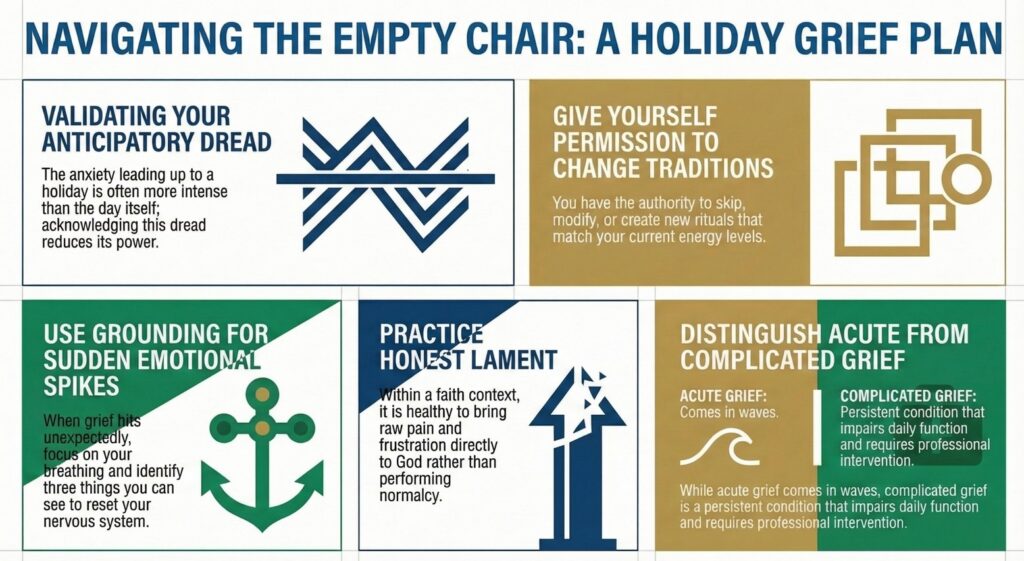
Anticipatory grief is the anxiety and sorrow that builds up before a difficult date arrives. You might start feeling tense weeks before a major holiday or the anniversary of a passing. Your mind and body physically remember the timeline.
Often, the weeks leading up to the day carry more weight than the day itself. The brain anticipates the pain and floods your system with stress hormones. You might find yourself snapping at your spouse or crying in the car line at your child’s school for no obvious reason. This dread is your mind trying to prepare you for an emotional impact. Acknowledging the dread directly takes some of its power away.
Why Anniversary Dates Can Feel Like Starting Over
Anniversary grief is the emotional recurrence of loss tied to a specific date. A death anniversary, a wedding anniversary, or a birthday can make you feel like you have lost all the progress you made over the past year.
You have not failed at grieving. Your brain is simply processing the passage of time and the permanent absence of your loved one. Milestone dates act as forced check-ins with your loss. The pain feels fresh again because the date demands you look directly at the empty space in your life. Expect these dates to be hard, and clear your schedule accordingly.
What You Are Feeling Is Normal And It Has a Name
Understanding your grief helps you manage it. Many people worry they are grieving incorrectly. There is no perfect way to navigate a profound loss. There are just different ways your mind attempts to heal. Getting clear on what type of grief you are carrying helps you figure out the exact next step to take.
The Difference Between Acute Grief and Complicated Grief
Acute grief is the initial, intense response to a loss. It hurts deeply but gradually integrates into your life over time. Complicated grief is a persistent condition where the intense sorrow does not fade, making daily functioning nearly impossible for an extended period.
| Feature | Acute Grief | Complicated Grief |
| Intensity | High initially, comes in waves | Remains constantly severe over time |
| Daily Function | Difficult but entirely possible | Severely impairs work and home life |
| Focus | Painful longing mixed with good memories | Intense preoccupation solely on the loss |
| Future Outlook | Eventual acceptance of a new normal | Deep belief that life has no purpose now |
A Practical Coping Plan for Hard Seasons
You need a concrete strategy to get through the holidays after a loss. Hoping the pain will just stay quiet rarely works. You need workable goals. This means looking at your calendar and making active choices about what you will and will not do this year.
Give Yourself Permission to Change the Rituals
You do not have to cook a big meal. You can skip the neighborhood party. Modifying your traditions is a basic survival skill. Talk to your family about what you have the energy to do this year. Choose the events that bring comfort and respectfully decline the ones that drain you.
If hosting Thanksgiving feels impossible, order a pre-made meal or go to a restaurant in Columbia. If decorating the house brings more tears than joy, leave the boxes in the attic. Traditions are meant to serve your family. When a tradition starts hurting you, you have the authority to change it.
Build In Moments of Acknowledgment, Not Just Distraction
Trying to ignore the elephant in the room takes massive energy. Dedicate a specific time to acknowledge your loved one. Light a candle at dinner. Share one favorite story. Leave an empty chair at the table.
Creating a contained space for grief prevents it from spilling over into every other moment of the day. When you give sorrow an assigned time, you relieve yourself of the pressure to suppress it. You can tell your family exactly how this will work. Keep it simple and honest.
Grounding Practices for When Grief Spikes Unexpectedly
Grief triggers will catch you off guard. A song at the grocery store or a specific smell can bring you to your knees. When this happens, use physical grounding techniques to regain your balance.
Focus on your breathing. Notice three things you can see and two things you can touch. Drink a glass of cold water. These physical actions help bring your nervous system back to the present moment. You cannot stop the trigger from happening, but you can control how your body responds to the sudden wave of panic.
Helping Your Children Through the Holidays After a Loss
Children process loss in bursts. They might cry one minute and play the next. Parents often feel immense pressure to manufacture a perfect holiday to protect their kids from the pain. This usually leads to parental burnout.
Kids grieve differently than adults and they are watching how you handle it. A few steady, honest conversations can do more than a perfect holiday performance. Here are practical ways to walk this season alongside your children.
- Keep their daily routines as normal as possible.
- Answer their questions honestly using plain language.
- Let them see you cry so they know it is okay to be sad.
- Involve them in creating a new family tradition to honor the person you lost.
Working through these strategies with a counselor makes them more effective and more personal. If you are in Lexington, Columbia, or anywhere in South Carolina, Crossroads Counseling offers same-week appointments and telehealth options across the state.
Help is available. Call 803-303-6770 to speak with our admissions team. Not ready for a call? Email us at info@crossroadscounselingsc.com, or by filling out our form on the contact us page where you can verify your insurance coverage.
When Faith Feels Distant in the Middle of Grief
You might feel guilty that your faith is not fixing your pain right now. Church services that used to bring peace might feel overwhelming. A faith-informed approach to therapy recognizes this reality. We believe lasting change happens when clinical skill meets spiritual grounding.
God handles our doubts and our anger. You do not have to pretend to be okay in the pew. Many Christians feel a quiet shame when they cannot simply pray their sadness away. Grief is a physical and psychological trauma. Treating it requires both spiritual care and clinical competence.
Lament Is a Biblical Practice And Grief and Faith Can Coexist
Lament is the spiritual practice of bringing your raw pain directly to God. Half of the Psalms are songs of deep sorrow and frustration. Your grief does not mean your faith is broken. It means you are human.
You can be deeply anchored in Christ and still need professional help to process the trauma of loss. We respect your values and integrate them naturally into our counseling process. We will never force faith into a session, but we welcome it fully when you want it there.
When to Reach Out for Support: Grief Counseling in the Midlands
Grief counseling in Lexington SC provides a safe place to untangle these heavy emotions. A trained clinician helps you make sense of the physical exhaustion and the mental fog. You do not have to wait until you are completely falling apart to ask for help.
We verify your insurance before your first session so you know exactly what to expect. You will leave your first session with a plan and tools to practice. Getting help is simply a matter of making one phone call and letting us guide you through the next step.
Frequently Asked Questions About Holiday Grief
Why does grief feel worse during the holidays?
Grief feels worse because holidays emphasize togetherness and family tradition. The absence of your loved one is magnified against the backdrop of cultural expectations for celebration and joy. The intense focus on family gatherings naturally highlights exactly who is missing.
How long does holiday grief last?
Holiday grief lasts as long as you need it to, though the intensity usually softens over the years. The first year is often the hardest, but subsequent milestones can still bring sudden waves of emotion. Healing is about integration, not a strict timeline.
What is anniversary grief and is it normal?
Anniversary grief is the resurgence of sorrow on specific dates like birthdays or death anniversaries. It is completely normal and simply reflects your brain processing the timeline of your loss. Your body physically remembers the trauma of the date.
How do I help my children through the holidays after a loss?
Help your children by answering their questions honestly and maintaining consistent routines. Let them participate in deciding how to honor the person you lost this year. Do not hide your own healthy sadness from them.
Can therapy help with grief during the holidays?
Yes, therapy provides concrete coping skills for navigating difficult family dynamics and intense emotions. A therapist helps you build boundaries so you can survive the season without severe emotional exhaustion.
How do I handle family gatherings when I am grieving?
Handle family gatherings by setting firm boundaries and having a clear exit plan. Drive your own car so you can leave early if the environment becomes too overwhelming. Communicate your limits to the host ahead of time.
Is it normal to feel angry or numb during the holidays after a loss?
Feeling angry or completely numb is a standard psychological defense mechanism against overwhelming pain. Your brain sometimes shuts down emotion to protect you from the overload. This numbness is temporary.
Does Crossroads Counseling offer grief counseling via telehealth in South Carolina?
Yes, Crossroads Counseling offers secure telehealth appointments for anyone residing in South Carolina. We also see clients in-person at our Lexington office for those who prefer face-to-face sessions.
Grief does not have a deadline, and healing does not have to happen alone. We would be honored to walk this season with you. Reach out anytime.
Start Your Admissions Today
- Call 803-303-6770 to speak with our admissions team.
- Email us at info@crossroadscounselingsc.com, or by
- Fill out our intake form on the contact us page where you can verify your insurance coverage.
Crossroads Counseling is located at 204 Caughman Farm Lane #101, Lexington, South Carolina.
Helpful Links
If you are in immediate distress or crisis, please use these free, confidential resources: