
You’ve probably tried just about everything. Maybe you started with a date night, or read a book about love languages and had a few difficult conversations that ended with familiar silence or loud arguments.
When a marriage feels like it is stuck in a loop of frustration, “trying harder” rarely works because you are often working against a biological and behavioral current you don’t fully understand.
At Crossroads Counseling, our team uses the Gottman Method to help couples in Lexington and across South Carolina build something more solid. We don’t believe in aimless talk therapy. We believe in a structured, evidence-based plan that respects your time, your values, and your desire for a home that feels like a sanctuary rather than a battlefield.
What Is Gottman Method Marriage Counseling
The Gottman Method is a research-based approach to couples therapy that focuses on observable behaviors and practical skills. Developed by Drs. John and Julie Gottman over 40 years of study, it identifies the specific habits that cause relationships to fail and the exact traits that help them thrive. Instead of just “talking about your week,” you learn to replace negative conflict patterns with positive connection.
Key Takeaways
- Research-Backed: Based on decades of longitudinal studies of thousands of real couples.
- Skill-Focused: You learn specific tools to manage conflict rather than just venting about it.
- Proactive: Focuses on building friendship and shared meaning, not just “fixing” problems.
- Structured: Follows a clear roadmap from assessment to specific goals.
- Local Access: Available in-person in Lexington, SC, or via telehealth throughout the state.
Marriage Counseling Using Gottman Therapy
Many couples come to our Lexington office feeling like their problems are unique or unsolvable. Usually, they are simply stuck in a predictable set of patterns. The Gottman Method identifies these patterns with clinical precision.
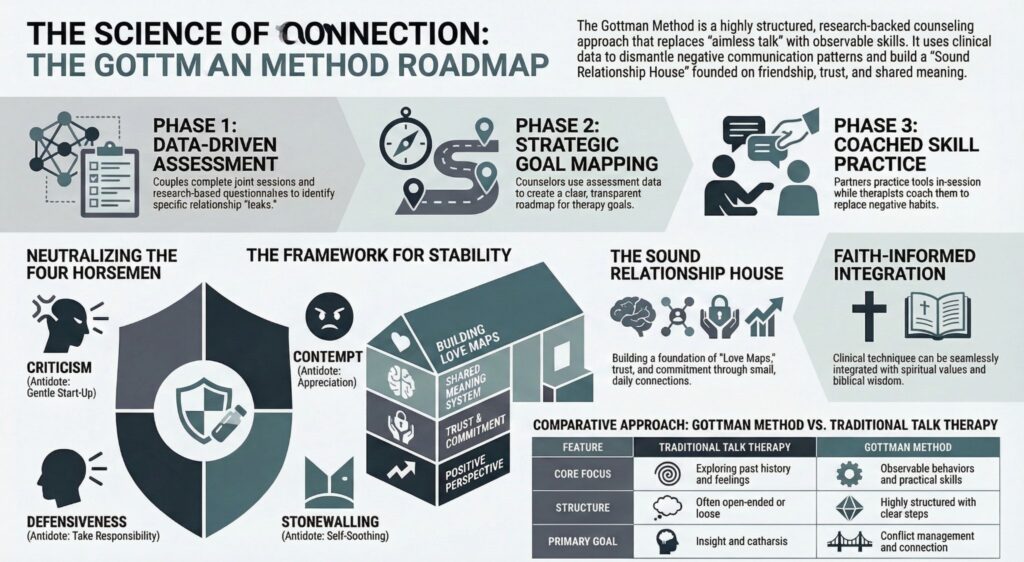
The Four Horsemen (and Their Antidotes)
Dr. John Gottman can predict with over 90% accuracy whether a couple will stay together based on how they argue. He identified four specific communication styles that act as “the four horsemen” of a relationship’s end.
- Criticism: This isn’t just a complaint. It is an attack on your partner’s character. “You always forget the dishes because you’re selfish,” rather than, “I’m frustrated the kitchen is messy.”
- Contempt: The most dangerous horseman. It involves mean-spirited sarcasm, eye-rolling, or name-calling. It is fueled by long-simmering negative thoughts and aims to make the partner feel despised.
- Defensiveness: This is really a way of blaming your partner. You aren’t taking responsibility; you’re making excuses so your partner backs off.
- Stonewalling: When one person shuts down, withdraws, or stops responding during a conflict. In our experience, this often happens when a person is “flooded” or physically overwhelmed by stress.
In therapy, we don’t just point these out. We teach the antidotes. You learn how to use a “gentle start-up” instead of criticism and how to build a “culture of appreciation” to block contempt.
Building a Sound Relationship House
The Gottman Method uses the metaphor of a house to describe a healthy marriage. The foundation is “Love Maps,” the act of actually knowing your partner’s inner world (their worries, their joys, their favorite coffee order). The walls are Trust and Commitment.
The levels in between include “Turning Toward” instead of “Turning Away.” When your spouse makes a “bid” for your attention, even something small like pointing out a bird outside or complaining about a coworker. How you respond matters. Over time, those small moments of connection build up a “reservoir of emotional bank account” that helps you survive the harder seasons.
Gottman Method Therapy in Lexington, SC
If you are skeptical of therapy because you don’t want to sit on a couch and be asked “how does that make you feel” for an hour, the Gottman Method will be a relief. It is a highly structured process.
- Assessment: You start with a joint session, followed by individual sessions and a detailed research-based questionnaire. This identifies exactly where the “leaks” are in your relationship house.
- The Plan: Your counselor maps out specific goals. You won’t guess what you’re working on; you’ll see the data from your assessment and agree on the path forward.
- Practice: Every session involves learning and practicing a skill. You leave with tools you can use the same night at the dinner table.
Your First Session
At Crossroads Counseling, your first session is about clarity. We verify your insurance before you walk in, so there are no financial surprises. We spend time hearing the story of your relationship—how you met, what drew you together, and where the wheels started to come off. By the end of the assessment phase, you will have a clear understanding of your relationship’s strengths and the specific habits that are currently causing pain.
What You’ll Work On Together
You will spend less time talking to the therapist and more time talking to each other while the therapist coaches you. If a conversation starts to spiral into one of the “Four Horsemen,” the therapist steps in. We provide a safe “container” to practice new ways of speaking so that by the time you’re back home in the Midlands, the new patterns feel more natural.
| Feature | Traditional Talk Therapy | Gottman Method |
| Focus | Exploring past history and feelings | Observable behaviors and skills |
| Structure | Often open-ended/loose | Highly structured with clear steps |
| Homework | Variable | Specific “experiments” and tools |
| Goal | Insight and catharsis | Conflict management and connection |
Is Gottman Method Marriage Counseling Right for You?
This approach works for couples at almost every stage. Whether you are “pre-marital” and want to build a strong foundation before the wedding, or you have been married 30 years and feel like roommates, the tools are the same.
It is particularly effective for:
- Recurring arguments that never seem to get resolved.
- Infidelity or betrayal recovery where trust needs a structural rebuild.
- “The Silent Treatment” or emotional distance.
- Couples who want a logical, “common sense” approach to therapy.
Faith-Informed Marriage Counseling in South Carolina
At Crossroads Counseling, we believe that clinical excellence and Christian values are not in competition. They are complementary. The Gottman Method is a brilliant clinical framework, but for many of our clients in Lexington and the surrounding Midlands, marriage is more than a social contract—it is a sacred commitment.
We integrate faith naturally and only as much as you want. We believe that God designed us for connection and that the “skills” Gottman discovered through research often mirror biblical wisdom regarding humility, forgiveness, and sacrificial love.
Whether you are meeting us at our Lexington office or connecting via telehealth from Columbia, Greenville, or Charleston, you will find a counselor who respects your values. We won’t make you choose between “good therapy” and “faith-based therapy.” You get both.
If you’re ready to stop cycling through the same arguments, let’s build a plan together.
Frequently Asked Questions
What is the Gottman Method and how is it different?
It is a research-based therapy focused on replacing negative conflict patterns with positive interaction. Unlike some methods that focus only on childhood trauma, Gottman focuses on the “here and now” behaviors that predict relationship success.
How long does it typically take?
While every couple is different, many see significant shifts in their communication within 10 to 12 sessions. The goal is to give you the tools to “become your own therapist” so you don’t need us forever.
Does it work for couples on the verge of divorce?
Yes. It is specifically designed to help “distressed” couples. By identifying the Four Horsemen, we can often stop the downward spiral and begin the work of repair, provided both partners are willing to try the new tools.
Can we do this via telehealth?
Absolutely. We offer secure, HIPAA-compliant video sessions for any couple living in South Carolina. It’s a convenient option for busy parents or those outside the Lexington area.
Does Crossroads offer faith-based counseling with Gottman?
Yes. Our clinicians are “faith-informed,” meaning we can weave Christian principles into the Gottman framework for clients who want their faith to be part of their healing.
What happens in the first session?
It’s an intake and story-sharing session. We learn your history, discuss your goals, and explain the assessment process. You’ll leave with a clear idea of what the next few weeks will look like.
How much does it cost?
Pricing is transparent. We verify your insurance benefits before your first appointment so you know exactly what your responsibility will be. Please contact our office for current private pay rates.
Is it backed by research?
Yes. It is one of the most studied forms of couples therapy in existence, based on four decades of data from thousands of couples in “Love Lab” settings.
The Next Step
You’ve done the research. You know that the current way of handling conflict isn’t working, and you’re tired of the weight that puts on your family. The next step is simple.
At Crossroads Counseling, we don’t do open-ended talk sessions that lead nowhere. We offer a structured approach, plain language, and a counselor who takes your marriage as seriously as you do. Whether you’re a working parent in Lexington feeling the burn of “marriage fatigue” or a skeptical professional who wants a practical plan, we are here to help.
Call us at 803-590-5822 or by email at info@crossroadscounselingsc.com. No waitlists. Insurance verified. A plan in place by the end of your first session.
Safety Resources
- Psychology Today: The Gottman Method
- National Institute of Health: Examining the Effectiveness of the Gottman Method
- American Addiction Center: Gottman Method Couples Therapy
- Harvard Health: Could Couples Therapy be Right For You
- American Association for Marriage and Family Therapy
- SAMHSA National Helpline: 1-800-662-HELP (4357)
- National Suicide Prevention Lifeline: 988