

The sunlight sparkles against your brand new engagement ring. You are feeling pure bliss as you prepare to marry the love of your life. But the engagement period can feel like a blur with so many tasks on your wedding day to-do list.
For Christian couples in South Carolina, marriage and faith are two important parts of your life. Premarital counseling at Crossroads Counseling Center can help you face the real questions that will shape your lives together.
Marriage is a covenant designed to reflect Christ’s relationship with the church. Your marriage will test you, refine you and ask more questions of you than you expect. Couples who last often face these challenges together and with the help of a counselor who can help you handle conflict and discuss topics without fighting to create a shared vision of what marriage means.
Why Premarital Counseling Matters for Christian Couples in South Carolina
Most couples wait years before seeking help for relationship problems. By then, patterns have hardened and repair is harder. Premarital counseling is preventive, surfacing issues before they become crises.
Many Christian couples assume shared faith means shared values. Two people can both love Jesus and still disagree fundamentally about money, parenting, or intimacy. Faith provides the foundation, but you still build the house. In Lexington, South Carolina, couples can access faith-integrated premarital counseling that combines clinical best practices with biblical principles. Christian Couples Counseling at Crossroads allows couples to work through practical topics while grounding conversations in scripture and prayer.
Communication: Learning to Speak and Listen Well
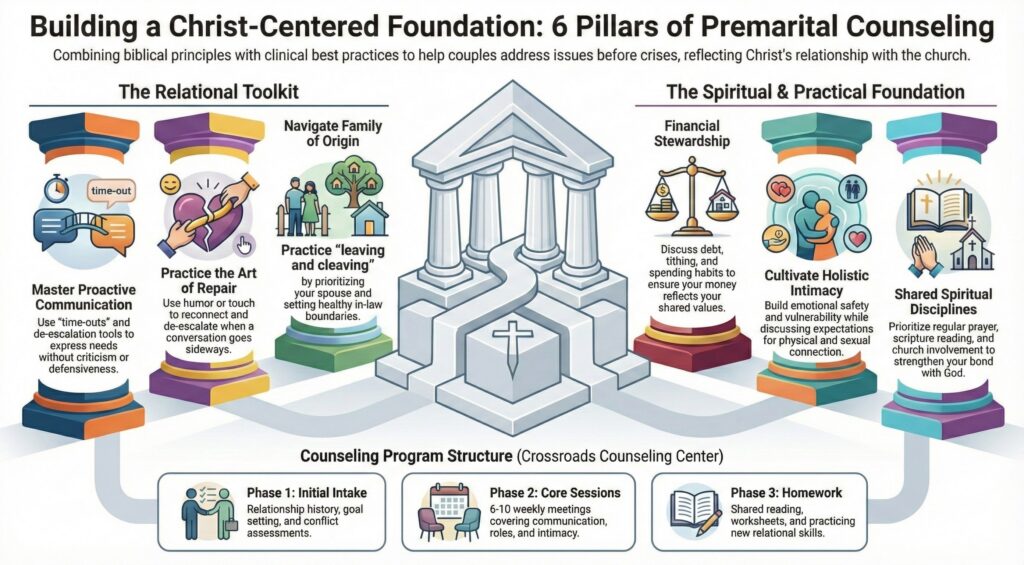
Communication in marriage is about being understood and making your partner feel heard, especially when you disagree. Christian premarital counseling often uses tools from Emotionally Focused Therapy and the Gottman Method to teach couples how to de-escalate conflict and repair after a fight. You’ll learn how to express a need without criticizing, listen without defending, and recognize destructive patterns.
One practical tool is the time-out. When a conversation starts escalating, either person can call a brief pause. This requires both of you to agree on the rules beforehand: Will you come back in 20 minutes or later that night? Working these details out in premarital counseling means you’ll have a plan when emotions run high.
Proverbs 18:21 reminds us that the tongue has the power of life and death. In marriage, you’ll have countless opportunities to speak life or to wound. Learning to communicate well is a spiritual discipline as much as a relational one.
Finances: Money as a Spiritual and Practical Issue
Money is one of the top sources of conflict in marriage. It’s about control, security, values, and what you believe money is for. One of you might be a saver who grew up watching parents stress over bills. The other might be a spender who believes life is short. Neither approach is wrong, but if you don’t talk about it, you’ll fight about it.
Premarital counseling asks couples to be honest about debt, credit scores, income, and how you’ll manage money once married. Will you combine accounts, keep them separate, or use a hybrid? Who will pay the bills and track spending?
For Christian couples, money is also a theological issue. How you handle finances reflects what you believe about stewardship, generosity, and trust in God’s provision. Do you tithe? What if one of you wants to give to a cause the other doesn’t value? What happens if one of you loses a job?
Setting financial goals early helps. Are you saving for a house? Paying off student loans? Writing down your priorities helps you make decisions that align with what matters. If you say you want to buy a home but you’re eating out five times a week, your spending doesn’t match your goals.
Sexual Intimacy: Expectations and Connection
Sex is often avoided in Christian premarital counseling, and that’s a problem. Whether or not you’ve been sexually active before marriage, you need to talk about what you expect, what you fear, and what intimacy will mean in your relationship.
If you’re waiting until marriage, discuss what that transition will be like. Physical intimacy on your wedding night might be awkward or uncomfortable. That’s normal. If you’ve never talked about it, the gap between expectation and reality can feel like failure when it’s actually just part of learning each other.
For couples who have been sexually active, past relationships, sexual trauma, guilt, or shame can all create barriers to intimacy. A Christian counselor can help you process those experiences in a way that honors your faith and your relationship.
Intimacy is also more than sex. It’s emotional closeness, vulnerability, and the sense that you’re known and still loved. Many couples struggle with intimacy because they don’t feel safe with each other emotionally. Premarital counseling teaches you how to create space for both physical and emotional intimacy.
Conflict and Forgiveness: Preparing for Hard Conversations
You will hurt each other. That’s reality. Marriage puts two sinners in close quarters and asks them to build a life together. The question is not whether conflict will happen but how you’ll handle it when it does.
Christian marriage counseling emphasizes the theology of forgiveness. Ephesians 4:32 tells believers to forgive as Christ forgave them. Forgiveness in marriage doesn’t mean pretending the hurt didn’t happen. It means choosing not to hold the offense over your partner’s head once the issue has been addressed.
Premarital counseling helps couples practice conflict in a controlled setting. You’ll learn how to bring up an issue without blaming, listen to criticism without shutting down, and apologize in a way that repairs damage.
One practical tool is the repair attempt. When a conversation goes sideways, a repair attempt is anything you do to de-escalate and reconnect. It might be humor, a touch, or acknowledging you’re both upset. Both of you need to recognize repair attempts and respond to them.
Family of Origin: Understanding Where You Come From
You’re marrying their family history and the patterns they’ve learned growing up. Every couple brings baggage from their family of origin. Some of it is good. Some should be left behind.
Premarital counseling asks couples to look at their families honestly. Ask what your parent’s marriage taught you about conflict, money, affection or faith. What roles did men and women play, and ask if you want to replicate that. These questions become concrete when you’re arguing about where to spend Christmas.
For Christian couples, family dynamics can involve differing views on church involvement, parenting, or how faith should be practiced at home. If one of you grew up in a home where church was central and the other attended sporadically, you’ll need to talk about what that means for your marriage.
Another key issue is boundaries with in-laws. When you get married, your primary loyalty shifts from your parents to your spouse. Genesis 2:24 says a man will leave his father and mother and be united to his wife. Leaving and cleaving is a command, and it requires intentionality.
Roles, Expectations, and Future Planning
Every couple comes into marriage with unspoken expectations about roles, often based on what they observed growing up. One partner might assume they will handle the cooking or the finances because of how their parents did it. If these deeply held assumptions aren’t discussed, they become a major source of frustration and conflict.
Christian Marriage Roles: Headship and Submission
For Christian couples, the discussion of roles extends into theological territory, including concepts like headship and submission. Denominations and individual couples interpret these biblical principles differently. Premarital counseling provides a safe, guided space to explore what Scripture says and how your unique dynamic will put those principles into practice, moving beyond cultural assumptions to a shared, Christ-centered vision.
Flexible Roles and Future Planning
Roles are not static; they must be flexible to handle the different seasons of life, especially with changes like new jobs or having young children. Beyond daily tasks, premarital discussions must also cover:
- Parenting Decisions: Do you want children? If so, how many and when? How will you approach discipline (grace vs. strictness)?
- Home and Education: What role will faith play in your home? Will you choose public, private, or homeschool education?
- Household Expectations: To prevent resentment, a practical exercise is to list all household tasks—from cleaning to car maintenance to paying bills—and decide who will own what. The goal is not a rigid 50/50 split but a division of labor that both partners feel is fair and equitable.
Faith and Spiritual Growth: Building a Christ-Centered Marriage
If your faith is central to your identity, it needs to be central to your marriage. Premarital counseling for Christian couples emphasizes spiritual disciplines like prayer, scripture reading, and worship as a couple. These practices strengthen your relationship with God and with each other.
How will you practice faith together? Will you pray together daily? Will you read scripture together? What if one of you is more spiritually disciplined than the other? Church involvement is another key issue. Will you attend the same church? What if you come from different denominations? What if one of you feel called to a ministry role that requires significant time?
Christian marriage is about two people helping each other become more like Christ. That requires humility, patience, and grace. Premarital counseling helps you understand what that looks like in practice.
What to Expect in Christian Counseling at Crossroads
Crossroads Counseling Center in Lexington offers premarital counseling that integrates faith and clinical best practices. The counselors use evidence-based approaches like Emotionally Focused Therapy and Gottman-informed skills, and they integrate scripture and prayer when that’s what you want. Couples counseling at Crossroads is available both in person and by telehealth across South Carolina.
Your first session will involve an intake where your counselor asks about your relationship history, your goals for counseling, and any specific concerns. Many counselors use assessments to help identify areas of strength and potential conflict.
Subsequent sessions dig into communication, finances, intimacy, conflict, family of origin, parenting, roles, and faith. Your counselor will assign homework between sessions like reading a chapter on marriage, completing a worksheet together, or practicing a skill. Most couples begin with weekly sessions. A typical program runs six to ten sessions depending on your needs.
Premarital counseling is not always comfortable. You’ll have conversations you’ve been avoiding and face differences you didn’t know existed. Better to have those conversations now with a counselor than later when the stakes are higher.
Paying for Christian Couples Counseling
Paying for therapy should not add extra stress to your wedding planning.
Crossroads Counseling Center is in-network with most commercial insurance plans. If you have insurance, sessions may be covered in full or require a copay. For those without insurance, Crossroads offers self-pay options. South Carolina Medicaid may also cover counseling services depending on eligibility.
Visit the center’s contact us page to verify your insurance.
Choosing the Right Counselor For Your Christian Couples Counseling
Look for someone with specific training in couples therapy. Certifications like Emotionally Focused Therapy (EFT) or Gottman Method training indicate advanced skills. A good Christian counselor will ask what role you want faith to play in your sessions and follow your lead.
Crossroads Counseling employs licensed counselors and associates who meet South Carolina state and national ethical standards. Review counselor profiles to find someone whose training fits what you’re looking for.
Getting Your Christian Couples Counseling Started
To begin premarital counseling, call Crossroads at 803-303-6770 or schedule online. Most couples can be seen within a week or two. Sessions are 50 minutes and available during the day or evening. Premarital counseling won’t guarantee a perfect marriage, but it will give you tools and a framework for handling the challenges ahead.
Helpful Links
For additional information on premarital counseling and Christian marriage, the following resources may be helpful:
- American Association for Marriage and Family Therapy
- American Association of Christian Counselors: Research on The Efficacy of Counseling
- Association of Certified Biblical Counselors
- Focus on the Family
- National Institute of Health: Spiritually Incorporating Couples Therapy
- The Gottman Institute
- International Centre for Excellence in Emotionally Focused Therapy